
Can Employers Require High Heels at Work in Ontario?
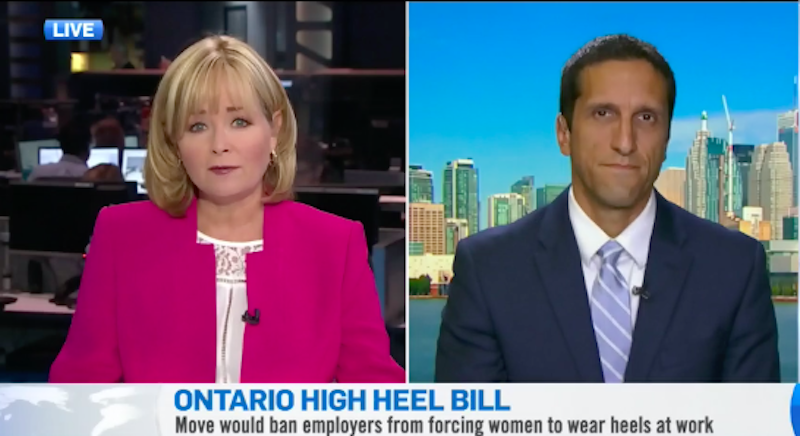
Ontario employment lawyers Lior Samfiru and Chantel Goldsmith spoke with CTV News and Global News in October 2017 about proposed legislation that would stop employers from forcing workers to wear high heels.
At the time of the interviews, gender-specific and sexualized dress codes could already violate Ontario’s human rights laws. However, employees did not have a clear and immediate workplace protection specifically addressing elevated heels.
Ontario has since changed the law.
On This Page:
- Can your employer make you wear high heels?
- How Ontario’s high-heel law changed
- High heels and workplace discrimination
- What our employment lawyers told the media
- What to do if your employer requires high heels
Can Your Employer Make You Wear High Heels in Ontario?
Generally, no.
Section 25.1 of Ontario’s Occupational Health and Safety Act prohibits an employer from requiring a worker to wear footwear with an elevated heel unless the elevated heel is needed for the worker to perform the job safely.
A restaurant, retail store or office cannot require women to wear high heels simply because management believes the footwear:
- Looks more attractive
- Fits the company’s image
- Appeals to customers
- Complements a uniform
- Has traditionally been worn by female staff
An employer can still establish a reasonable workplace dress code. For example, it may require employees to wear clean, professional or non-slip footwear. However, the policy can’t conflict with occupational health and safety or human rights laws.
Are There Exceptions?
The elevated-heel prohibition does not apply to performers working in the entertainment and advertising industries.
This can include actors, dancers, models and other performers who may need to wear specific footwear as part of a genuine performance.
An employer can’t avoid the law simply by giving an ordinary employee a different job title. A server does not become a model merely because the employer refers to them as one.
How Ontario’s High-Heel Law Changed
In October 2017, Liberal MPP Cristina Martins introduced Bill 168, the Putting Your Best Foot Forward Act.
The bill proposed changing Ontario’s workplace safety legislation so employers could not require footwear that was unsafe or prevented an employee from safely performing their work.
Bill 168 passed second reading on October 19, 2017, but did not proceed to Royal Assent.
However, a similar elevated-heel prohibition was added to Bill 148, the Fair Workplaces, Better Jobs Act, 2017. Bill 148 received Royal Assent on November 27, 2017, and the footwear provision became part of Ontario’s Occupational Health and Safety Act.
Why Was a Specific High-Heel Law Needed?
Before the footwear provision was enacted, an employee could argue that a mandatory high-heel policy was discriminatory under the Ontario Human Rights Code.
The Ontario Human Rights Commission had already warned employers that sexualized and gender-specific dress codes could violate the Code. Examples included requiring female employees to wear:
- High heels
- Short skirts
- Tight or revealing clothing
- Low-cut tops
- Makeup or specific hairstyles
The problem was that enforcing those rights could involve filing an application with the Human Rights Tribunal of Ontario and waiting for the matter to be decided.
That left employees with an immediate practical question: What should they do during their next shift?
Should they comply with the policy, refuse to wear the shoes or risk losing shifts and facing discipline?
The elevated-heel prohibition created a much clearer workplace rule. It also provided protection against reprisals for workers who sought to have the Occupational Health and Safety Act followed.
High Heels and Workplace Discrimination
A dress code does not need to use the word “mandatory” to create a legal problem.
An employer might say that high heels are merely “encouraged,” while employees understand that refusing could result in:
- Fewer shifts
- Less desirable assignments
- Lost tips
- Discipline
- Being sent home
- Not being hired
- Losing their job
An informal expectation can still be discriminatory or unlawful if employees are effectively punished for refusing to follow it.
Can Employers Have Different Dress Codes for Men and Women?
Gender-specific dress requirements can violate the Ontario Human Rights Code when they impose unequal or sexualized expectations.
An employer would need to demonstrate that a gender-specific requirement is genuinely connected to the employee’s ability to perform the job. Wanting workers to look more attractive is not a legitimate occupational requirement.
Workplace Discrimination can also occur during the hiring process. An employer may violate human rights laws if it refuses to hire someone because they are unwilling to wear sexualized or gender-stereotypical clothing.
What Our Employment Lawyers Told the Media
Four interviews with Samfiru Tumarkin LLP employment lawyers examined the proposed high-heel ban, the limitations of the existing human rights process and the power imbalance between employers and vulnerable workers.
Lior Samfiru on CTV News Channel
Lior Samfiru joined CTV News Channel on October 17, 2017.
He explained that mandatory high heels were particularly common in service industries where gender-specific uniforms had traditionally been treated as normal.
While employees could already raise a human rights argument, the proposed law would give them a more immediate ability to refuse elevated heels without being penalized. It would also expose employers to enforcement for requiring the footwear.
Lior Samfiru on Global News Radio 980 CFPL
Samfiru also joined Andrew Lawton on Global News Radio 980 CFPL on October 17, 2017.
He explained that aesthetics are not a legitimate reason for requiring gender-specific footwear. A genuine occupational requirement must be connected to the employee’s ability to perform the actual job.
The interview also examined why employment laws establish minimum protections that employees cannot waive, even when they appear to have agreed to a workplace policy.
Employees may accept uncomfortable or unsafe conditions because they need the job and believe the employer holds all the bargaining power. Minimum employment standards exist partly to protect workers in that vulnerable position.
Lior Samfiru on Global News
On October 18, 2017, Samfiru spoke with Farah Nasser on Global News.
The report included accounts from workers who described spending long shifts on their feet in high heels and experiencing cuts, bleeding and significant discomfort.
It also highlighted the indirect pressure employees can experience when employers describe heels as “encouraged” while most employees understand that they are effectively expected to wear them.
Samfiru explained that the proposed legislation would create a more accessible remedy than requiring an employee to first pursue a lengthy human rights proceeding.
Chantel Goldsmith on CTV News
Chantel Goldsmith joined Ken Shaw on CTV News on October 19, 2017.
Goldsmith explained that the Ontario Human Rights Code already provided protection against discriminatory gender stereotypes in workplace clothing policies.
The proposed legislation would provide further protection by preventing employers from disciplining or otherwise penalizing employees who refused to wear unsafe footwear.
She also addressed discrimination during the hiring process. When an employer imposes a clothing requirement that an applicant believes is discriminatory, the employer may have to demonstrate that the requirement is a bona fide occupational requirement genuinely connected to the job.
Can an Employer Punish You for Refusing to Wear High Heels?
An employer should not fire, discipline, intimidate or otherwise penalize a worker for seeking compliance with Ontario’s workplace safety laws.
A reprisal could include:
- Reducing the employee’s shifts
- Sending the employee home
- Moving them to a less desirable position
- Suspending or disciplining them
- Threatening their job
- Terminating their employment
A mandatory or indirectly enforced high-heel policy could also raise separate concerns under the Ontario Human Rights Code, particularly when the requirement is based on sex, gender identity, gender expression, disability or another protected personal characteristic.
What Should You Do if Your Employer Requires High Heels?
If your employer requires or pressures you to wear elevated heels:
- Ask about the policy in writing. Determine whether high heels are formally required or informally expected.
- Request a safe alternative. Explain that you are prepared to follow a reasonable dress code using professional, safe footwear.
- Keep records. Save emails, messages, schedules and copies of any written policies.
- Document changes to your employment. Record any lost shifts, disciplinary comments or changes made after you objected.
- Do not resign before getting legal advice. Resigning could affect your ability to pursue compensation or other remedies.
- Speak with an employment lawyer. A lawyer can determine whether the employer’s conduct involves workplace safety, human rights, wrongful dismissal or reprisal concerns.
Speak With an Ontario Employment Lawyer
Workplace dress codes must comply with Ontario’s occupational health and safety and human rights laws.
Your employer can’t impose an unlawful footwear requirement simply because it believes high heels are attractive, traditional or beneficial to its image.
If you have been disciplined, lost shifts, sent home or fired after refusing to wear high heels or other discriminatory clothing, contact Samfiru Tumarkin LLP. Our Ontario employment lawyers can review your situation and explain your options.
About the Author

Lior Samfiru
Lior Samfiru is a Founding Partner at Samfiru Tumarkin LLP and the Practice Leader of the firm’s Labour & Employment Law Group. Known for his advocacy and success representing both employees and employers, Lior exclusively serves clients in Ontario, where his extensive experience has made him one of Canada’s most sought-after employment lawyers.
More about Lior SamfiruRelated Posts

eBay Announces More Layoffs: 9% Of Workforce To Be Cut
eBay announced layoffs affecting 9% of its workforce on October 21, 2026. Find out what happened and what affected Canadian employees could…

TC Transcontinental Closing Owen Sound Plant: 360 Employees Affected
TC Transcontinental will close its Owen Sound printing plant in January 2027, affecting 360 employees. Find out what happened and your severance…
eBay Layoffs 2026: Latest Job Cuts And Severance Pay
eBay announced layoffs affecting 9% of its workforce in October 2026, following 800 job cuts in February.